
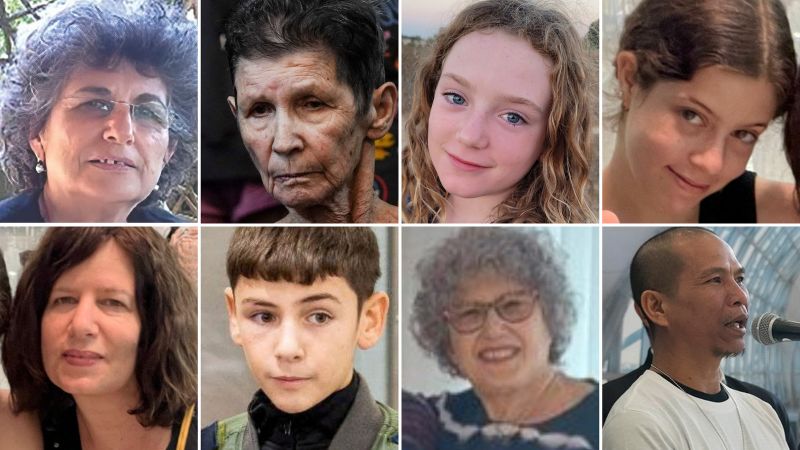
Kept in the dark. Forced to sit in silence. Fed only meager rations. These and even more chilling scraps of information are beginning to show how hostages survived in Hamas captivity.
Around 240 people, from infants to octogenarians, were taken hostage during Hamas’ attack on Israel on October 7. Dozens have been freed but many more remain missing, presumed to be held by the Palestinian militant organization and other groups in Gaza, as the warring sides resume battle.
The Red Cross and other humanitarian groups have not been allowed to visit the hostages. So relatives and the wider watching world have to wait for testimony from those who have been freed to know what might be happening to their loved ones still held in Gaza: whether they have been seen, if they are alive or dead.
The details below have been compiled from comments by freed hostages to their families, their carers and sometimes to reporters.
Under the terms of the deal between Israel and Hamas, most of those released are women, children and foreign workers. As of Friday, only one adult Israeli man – who also had Russian citizenship – had been released and no members of the Israeli military. Hostages are believed to be spread across locations and in the hands of different groups. It’s already seeming that not all hostages were treated the same way; the story of each new person recovered will add to the understanding.
Kept in the dark amid ‘nonstop bombing’
Adina Moshe was dragged from her safe room at home in Israel, taken to Gaza and forced into tunnels five stories underground, her nephew Eyal Nouri said.
Moshe said his aunt was held in an underground room where the lights were switched on for only two hours a day. The darkness was literal and also figurative, Nouri said. Deprived of any information, their other senses and imaginations became keener.
“They didn’t know anything about what happened above,” Nouri said. “They just heard the nonstop bombing until the day before their release. Suddenly, there was amazing silence and they knew something was going to happen but they didn’t know what.”
The network of tunnels under the built-up enclave of Gaza described by Adina Moshe matched the testimony of Yocheved Lifshitz, an 85-year-old grandmother released early in the conflict, outside the terms of the truce.
“It’s her birthday on the 17th of [November]. She will be 9,” he said. “She won’t even know what day it is. She won’t know it’s her birthday. There will be no birthday cake. No party, no friends. She will just be petrified in a tunnel under Gaza. That is her birthday.”
Hand was taken aback after her release when Emily told him that she, her friend Hila Rotem-Shoshani and Hila’s mom Raaya Rotem, were imprisoned above ground, in a series of houses. That came with dangers of its own. As Israeli forces attacked Gaza, moving deeper and deeper into the Palestinian territory, Rotem and the girls were forced to run from building to building.
“That’s terrifying. Being pulled, dragged, pushed … under gunfire probably,” Hand said. An estimated 40-50% of buildings in northern Gaza have been damaged, independent researchers say, and the United Nations’ Office for the Coordination of Humanitarian Affairs said on Wednesday up to 1.8 million people in Gaza, or nearly 80% of the population, are thought to be internally displaced.
Hand was right about Emily losing track of time. Released on the 50th day of captivity inside what she called “the box,” the little girl told her father she thought she had been gone for a year.
Forced to endure in silence
“The most shocking, disturbing part of meeting her was she was just whispering, you couldn’t hear her. I had to put my ear on her lips,” Hand said of Emily. “She’d been conditioned not to make any noise.”
Both Emily and Hila dared only to whisper, even once they were back with their families. Three days later, Hand said he could hear Emily from about a meter (three feet) away when she talked, but when she cried she buried herself under bedclothes and was almost silent.
She had learned the Arabic for “keep quiet!” Hand said. Child hostages were only allowed to draw or play cards without making noise.
Omer Lubaton Granot, who founded the Hostages and Missing Family Forums, said a gun was held to Eitan’s head to threaten him if he would cry.
“What we hear from the stories from children – the captivity’s harsh reality is unbelievable,” Granot said. “Sisters of other children told them that Hamas have told the children that their whole family has died, that nobody wants them back, that they don’t have a home to go to. They tried to scare the children.”
Fed survival rations
Captives ate the same food as the guards, according to Lifshitz, who was released with her neighbor on October 24.
Grandmother Ruth Munder told Israel’s Channel 13 conditions got worse as the captivity went on, and as Israel’s vise on Gaza tightened. UN officials have warned of “massive outbreaks of infectious disease and hunger” in the enclave due to Israel’s strict blockade on all imports beyond a small amount of humanitarian aid.
At the beginning, a guard brought chicken, rice, canned goods and cheese for the hostages. “When we got up we had tea and in the evening once again tea and sweet things for the children,” Munder said, “until the economic situation started to be bad and people were hungry.”
Adina Moshe said in her tunnel room, “They were fed only rice, some beans from cans, which they tried to avoid eating so as not to have stomachache,” her nephew reported.
Emily Hand told her father that they always had breakfast and sometimes lunch or an evening meal. She said she was so hungry she learned to like plain bread with olive oil. Since her release she’s wanted to eat “like a horse,” her father said, but they are restricting intake for now while her shrunken stomach recovers.
It’s a similar story for other former captives, whose weight loss and pale skin jolted the relatives welcoming them home.
Thai former captive Uthai Saengnuan said his concern was with his countrymen still in captivity.
Physical and mental wounds
Eitan, the 12-year-old, was beaten when he arrived in Gaza, his aunt also said. “Perhaps I was naïve but I thought he would be well-treated. But no, they are monsters,” she said of his Hamas captors.
Emily Hand said she was not hit and her father said he believed harsh voices were enough to make her do what was wanted.
“She’s a little bit distant now, she’s a little bit cold,” he said. “She talks about things that happened like it’s in third person, like it happened to someone else. She’ll say she saw horrible things, but she says it with a straight face.”
Thomas Hand said Emily suffered insect bites too. “Her head is full of lice, absolutely full of head lice. I’ve never seen so many in my life.”
He said he and his older daughter worked in tandem with combs. “Just one pass and the thing was full, full of little black creatures.”
Elma Avraham, 84, was seriously ill when she returned from Gaza, first needing a ventilator as she fought to survive in hospital.
Dr. Hagai Levine, head of the medical team for the Hostages and Missing Family Forums, said her body told its own harrowing story.
“You can see on her body that she was dragged from place to place, that she was handcuffed,” he said. “She has chemical wounds from not treating her basic needs.”
First steps to recovery
Rehabilitation will take time. Former detainees may experience a range of layered psychological impacts including anxiety, depression, disorientation, grief, post-traumatic stress and survivor’s guilt, experts say.
Many hostages lost their homes in the October 7 attacks; as they return, some are also finding out how many of their friends and relatives were killed.
But Dr. Efrat Bron-Harlev, chief executive officer of the Schneider Children’s Medical Center of Israel, where some of the hostages have been treated after being released, said what the staff had seen so far made them optimistic.
“We heard from many of the children and women unimaginable accounts, some of them really surreal. We have heard stories, which are hard for us as doctors and as caregivers to believe they can exist,” Bron-Harlev said.
But their patients were strong and determined.
“Over the last five days, we met children who were initially withdrawn and lost, and after a day or two, they were already running around the ward, playing and laughing.”
Israel said Friday it believed 137 hostages taken captive on October 7 remained in Gaza.