
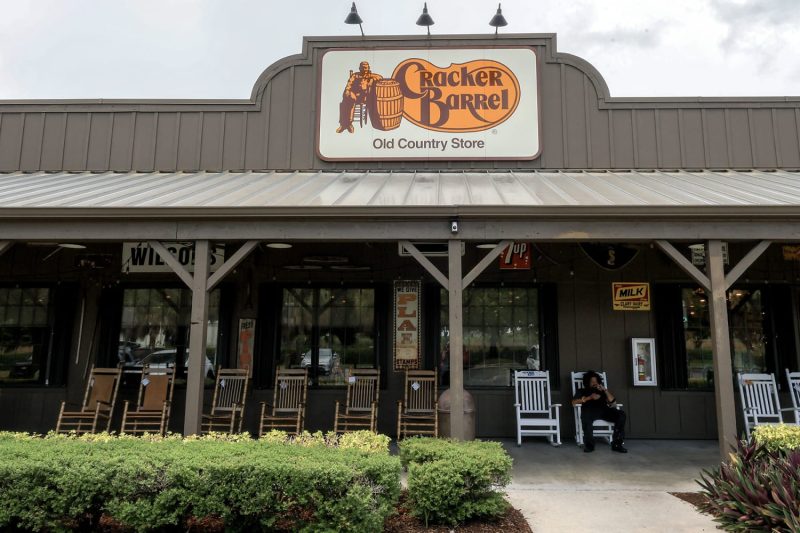
It’s been a busy week for Cracker Barrel Old Country Store’s marketing team.
The restaurant chain announced a rebrand and new logo last week, faced widespread criticism from social media users, including President Donald Trump, and proceeded to walk back its plan to change the logo.
In that span of time, the company lost and regained almost $100 million in market value, bringing it about back to where it started. The stock gained 8% on Wednesday.
The Cracker Barrel saga is just the latest example of a consumer-facing company making big branding decisions, then pulling back after alienating its customer base.
“It’s very tricky to be a brand for everyone today,” Carreen Winters, president of reputation at the global public relations firm MikeWorldWide, said in an interview. “Legacy brands are particularly tricky, because you have to figure out what is cherished and authentic from the old and marry it with the new.
“In Cracker Barrel’s case, they’re trying to attract a new, younger customer [which] is no longer sufficient,” she continued. “You need to actually think about all of your stakeholders and how they will react, respond, feel about what you’re doing or the direction you’re taking. And you need to be sure that what you’re doing is consistent with shared values.”
Rebranding failures are not a new phenomenon. One of the most famous marketing blunders of all time happened in 1985 when the Coca-Cola company introduced “New Coke” with a new formula. After a firestorm of outrage from its customers, the company returned to its classic formula a few months later.
But social media has made backlash from consumers faster and more widespread, meaning businesses are usually quicker to walk back on their branding failures.
In 2010, retailer Gap ditched its decades-old blue box logo for a more minimalist design. It faced intense backlash on social media through thousands of engagements and, within less than a week, the company said it was reverting to its original logo.
More recently in May, Warner Bros. Discovery announced its streaming platform would undergo another name change, after switching from HBO to HBO Max to Max and then back again to HBO Max.
Major rebrands don’t always go awry. For example, Kentucky Fried Chicken successfully rebranded to KFC in 1991. Its customers already used the acronym and the rebrand signified that the restaurant chain offers more than just fried chicken.
Dunkin’ Donuts also successfully underwent its name change to Dunkin’ in 2019. It did face some criticism from its loyal customers at the time, but Winters said today the “Dunkin’” name and branding are widely accepted over its original name.
“Dunkin’ rebranded in accordance with the behavior that the customer created,” she said. “It aligned with their strategy of being more than Donuts and really building their coffee business.”
She also mentioned IHOP as an example of a brand that has been able to freshen up its look and stay relevant in culture. She said IHOP’s change has been an “evolution, not a revolution.”
Beth LaGuardia Cooper, chief marketing officer at Advantage, The Authority Company, added during an interview that Starbucks had subtle changes to its logo over time, which allowed it to hold the base of its identity close.
While some social media users disliked Cracker Barrel’s new branding simply because they said it lacked substance and was too “sterile” or “soulless,” others, especially conservatives, claimed the new logo leaned into “wokeness” and diversity efforts.
Cracker Barrel is widely considered a classic American restaurant chain. It began in Tennessee in 1969 and its branding evokes Southern charm and nostalgia for its consumer base.
Eric Schiffer, chairman of the firm Reputation Management Consultants, said the new branding, without the iconic “Uncle Herschel” figure, suggested to conservatives that having a white man featured on the logo was wrong or politically incorrect.
He said that pushback represents a larger trend where conservatives are feeling under attack by diversity, equity and inclusion efforts.
“I think the perspective of conservatives is, don’t ruin Cracker Barrel with the Bud Light meets Jaguar marketing playbook,” said Schiffer, adding that those brands “attempted to disrupt positively and what they did was they nuked brand sentiment and shareholder confidence.”
In November, Tata Motors-owned Jaguar Land Rover announced a rebrand that removed its “leaper” big cat imagery from its logo and changed the brand’s font. Its new promotional materials included brightly dressed models, but no cars. The brand faced significant pushback, including tens of thousands of responses on social media.
Elon Musk criticized the company on X at the time, asking Jaguar’s official account: “Do you sell cars?”
Earlier this month, Trump piped in with his insults, calling Jaguar’s ad campaign “stupid” and “seriously WOKE.”
The Telegraph reported in May that Jaguar was searching for a new advertising agency after the public backlash.
Similarly, Anheuser-Busch InBev’s Bud Light faced heavy criticism from conservatives in 2023 after a collaboration between the beer brand and social influencer Dylan Mulvaney, who is transgender.
“If you’re trying to be a tough, male-focused, football fan-oriented beer, the last thing you want to do is put the wrong spokesperson in front of the brand,” Schiffer said. “It will turn off that audience and it allows competitors to capture that market share.”
“The throughline in all of this is, don’t rip apart and disrespect audiences that brought you to the dance,” Schiffer said. “Find a way, if you’re going to want to expand, do it in a way that doesn’t cut at the core of what the brand stands for — and in the process, create cognitive dissonance and blow up market cap.”
Branding experts told CNBC that at the end of the day, people are talking about Cracker Barrel, which is a win for the company by itself.
“Everybody loves a comeback in America,” LaGuardia Cooper said. “So I would root for them to make this happen, make something good out of it.”